Why the 4-Year Cycle Is Not Dead

Fading the Noise: Why the 4-Year Cycle Is Not Dead
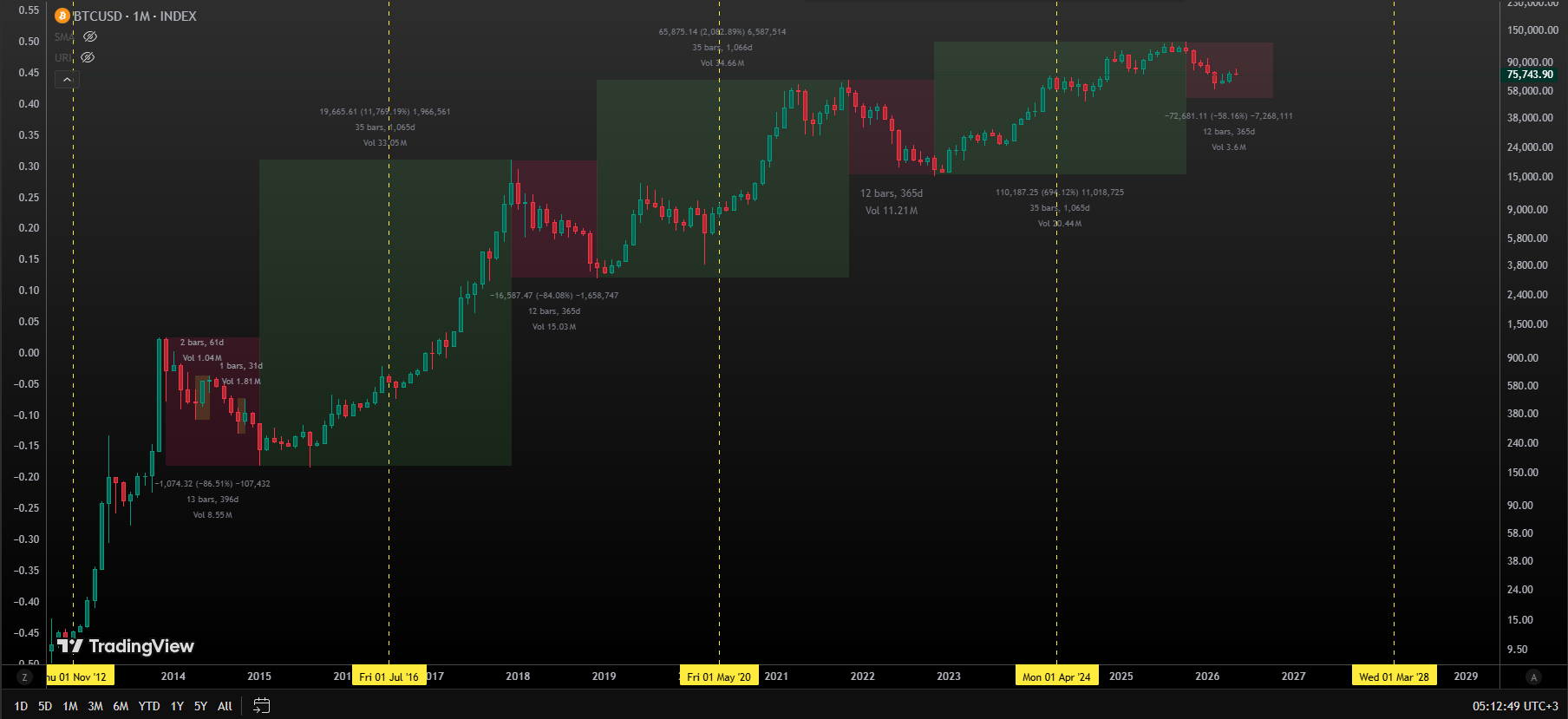
- Institutional Narrative is Noise: Despite ETF inflows and corporate adoption, Bitcoin continues to adhere strictly to its historical macroeconomic timeframes.
- Apathy Does Not Prevent a Bear Market: A market does not need retail euphoria to top; historically, macro markets frequently collapse from apathetic peaks.
- The Classic Bear Market Rally: The current bounce to the 200-day moving average is a structural trap to lure retail capital, and is historically weaker than previous mid-cycle rallies.
Narrative vs. Objective Data
Financial markets have a relentless need to find emotional justifications for price action. Driven by ETF inflows, corporate treasury acquisitions, and rumors of strategic reserves, it is easy to adopt the "this time is different" narrative. However, objective data presents a completely different reality: Bitcoin reached its cycle top almost exactly within the same historical time window it always has—the fourth quarter of the post-halving year.
The cycle is not dead. It is simply playing out within a new institutional environment.
Apathy Cannot Prevent a Bear Market
A primary argument for a broken cycle is the lack of massive retail euphoria during the recent peak. This is a dangerous illusion.
If we analyze historical macro data, such as the behavior of the S&P 500 in the 1960s and 1970s, the exact same pattern emerges. Markets established new highs and then collapsed into brutal, multi-year bear markets, despite topping out purely on apathy. The laws of financial physics remain intact: an asset class does not require euphoria to trigger a bear market; a simple drying up of liquidity is sufficient.
The Anatomy of a Bear Market Rally: Shattering Illusions
When you are inside a cycle, every bottom and every bounce feels absolutely unique. The current rally to the 200-day moving average is generating new FOMO, but the data is ruthless. The recent 35 to 36% bounce from the bottom is actually notably weaker than the massive 46% bear market rally we witnessed in 2022 before the market finally capitulated.
Every previous cycle (2014, 2018, 2022) has painted the exact same structural picture: a drop, a painfully long sideways consolidation, and a strong counter-trend rally that briefly breaches the 200-day moving average to instill a false sense of security. If the cycle maintains its mathematical rhythm, true time-based capitulation and the ultimate cycle low should not be expected until the fourth quarter of the midterm year—late 2026.
The Macro Investor View: Smart capital does not sit emotionally glued to a Bitcoin chart, expecting a new supercycle off every 5% pump. While crypto undergoes its fundamental purge, other sectors—equities, energy, and manufacturing—offer systemic growth. True wealth is generated by ignoring social media narratives and aligning strictly with the cold, mathematical rhythm of the market cycle.
As long as the data confirms that this time-based cycle remains intact, I will continue to buy and sell strictly according to its rhythm. There is zero logical reason to pivot from a structural model that is clearly not broken. However, looking further down the macro horizon, I have no illusions that this four-year cycle will last eternally. Once the cycle inevitably flattens out and cycle-over-cycle returns compress to below 100%, the asymmetric upside is dead. At that threshold, allocating capital to Bitcoin purely for the sake of aggressive financial yield will no longer make mathematical sense. Until then, we trade the cycle.