The Macro Perspective: Why the Market is Fundamentally Mispricing Tesla's Potential
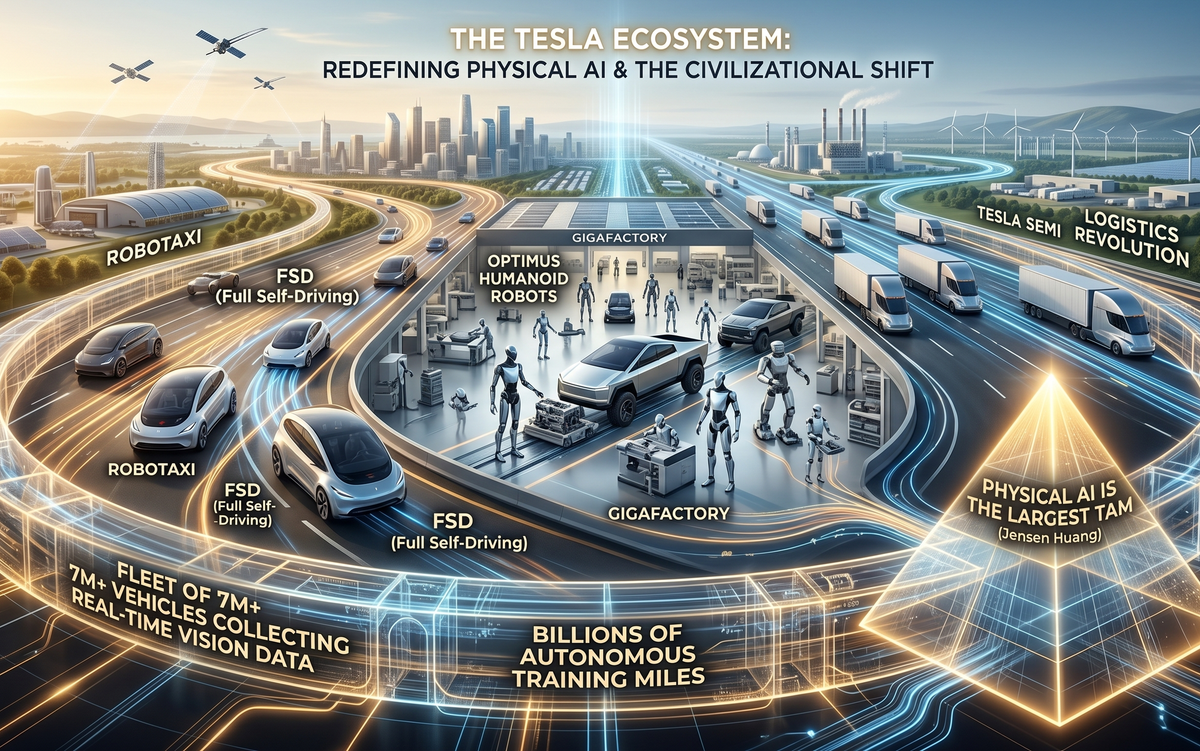
For many investors and the broader public, Tesla remains simply a car manufacturer competing with legacy auto brands. This is a fundamental miscalculation. Zooming out, Tesla is a deep-tech company evolving at a rapid pace, with a Total Addressable Market (TAM) that is virtually unprecedented.
To understand Tesla's true valuation, one must look at its TAM. While the legacy auto industry is capped by the global volume of vehicle sales, Tesla is not targeting just the automotive market—it is targeting the physical world's artificial intelligence. As Nvidia CEO Jensen Huang has acknowledged, "physical AI" represents the absolute largest and most important TAM in the global economy.
Tesla is no longer a single-product company; it is an ecosystem of multiple maturing verticals. This includes autonomous transport (Robotaxi and Full Self-Driving), which transitions the vehicle from a one-time product to a recurring software revenue model, unlocking a multi-trillion-dollar transport market. It includes the logistics revolution with the Tesla Semi, fundamentally changing the economics of global heavy freight. Furthermore, it encompasses humanoid robotics (Optimus), aimed directly at the manufacturing sector and global labor shortages, with robotic production lines already physically replacing traditional auto lines in Fremont. Add to this the synergy with the broader technological ecosystem, where assets like Starlink provide necessary high-speed global connectivity.
Is there anyone in the world competing at this scale and synergy? The reality is that there is no true peer. No competitor has a fleet of over 7 million vehicles on the road, actively collecting real-time vision data and having already logged billions of autonomous training miles. This is an unparalleled, compounding infrastructure moat that cannot be replicated from a standstill.
When viewing this through a long-term macro lens, it becomes clear that Tesla is not merely an automotive business chasing quarterly vehicle margins. It is an entity that, in its current state, holds the potential to drive a civilizational shift—redefining global transport, industrial manufacturing, and the fundamental nature of physical labor.