The Monetary Horizon: How Bitcoin, Gold, and AI Are Reshaping the World
Executive Summary
- The Broken Yardstick: The fiat system is an illusion where we measure our wealth with a constantly shrinking ruler; saving is mathematically destined to fail.
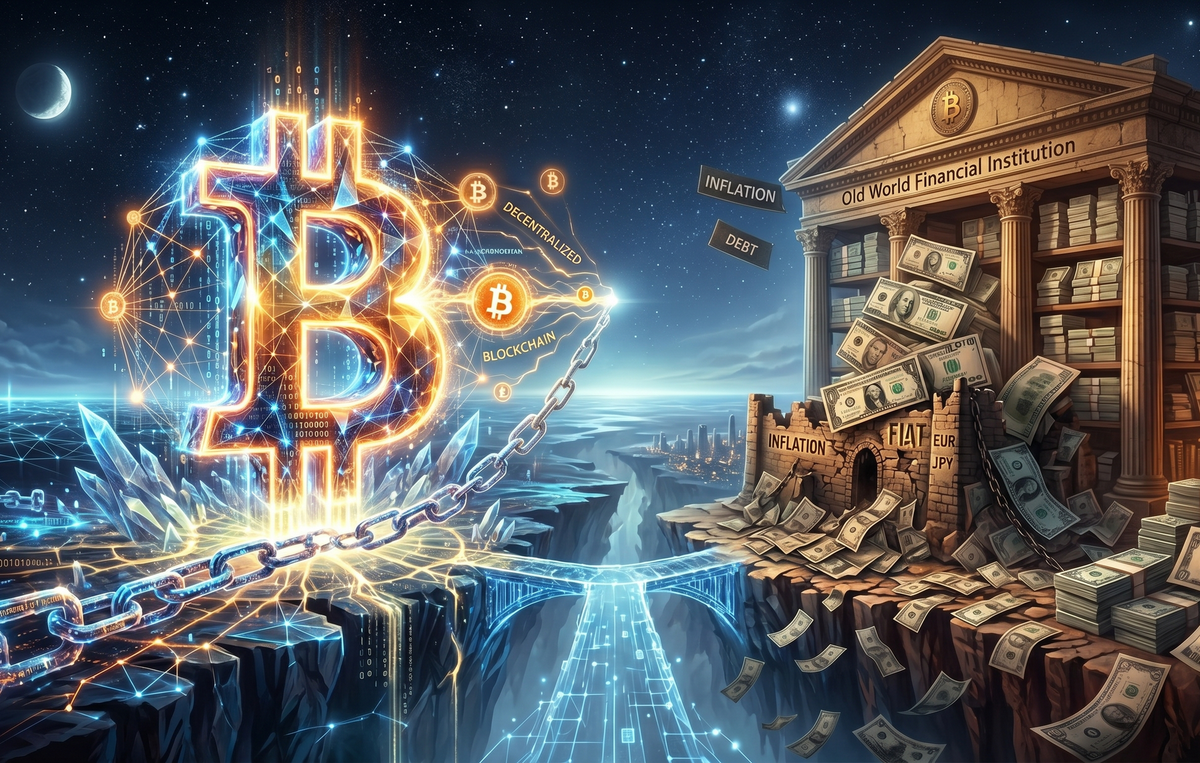
- The Ratchet Effect: Bitcoin's true trajectory is measured against gold, not the dollar, revealing a cyclical absorption of the old world's premium.
- The Twin Singularities: The convergence of Artificial Intelligence (driving production costs to zero) and sound money (fixing the supply) will create extreme deflation, forcing a civilizational shift.
The Illusion of the Broken Ruler
We live in a financial illusion. We measure our wealth, the fruits of our labor, and our future plans with a yardstick that is constantly changing. When we observe that "housing prices increased" or "the stock market hit a record," we intuitively assume that value has grown. However, in most cases, the value remained stagnant; it was simply the measuring stick—the dollar or the euro—that shrank.
This is the reality of the fiat world: a system where money is printed from thin air and where holding cash is a mathematical guarantee of loss. But what happens if we discard this elastic ruler and adopt a "hard" standard? What happens when we view the macro landscape strictly through the prism of Gold and Bitcoin? We are witnessing the inevitable transition from a debt-based economy to an asset-based economy.
The King Born in Gold's Shadow
To understand Bitcoin's true trajectory, one must disregard dollar-denominated charts. The dollar is noisy and heavily manipulated. The true signal lies in the ratio: Bitcoin versus Gold.
Historically, gold has served as humanity's ultimate safe haven—a store of value that cannot be printed. When we price Bitcoin in ounces of gold, a distinct pattern emerges, which we can call "the vacuum of value" or The Ratchet Effect. Every four to five years, Bitcoin makes a quantum leap, absorbing a larger piece of gold's purchasing power.
In 2011, one Bitcoin could buy exactly one ounce of gold. Today, it buys dozens.
The critical metric is not the cycle top, but the floor. After every major parabolic run and subsequent correction, Bitcoin rarely falls back to the previous cycle's low against gold. This represents the inexorable victory of a young, superior technology over an analog predecessor. The market is actively replacing its global reserve asset.
Hyperbitcoinization & The Plateau of Stability
Skeptics often point to Bitcoin's volatility as proof that it can never function as money. This is a fundamental miscalculation—they are confusing the explosive growth phase with the ultimate maturity phase.
We are currently observing the law of diminishing returns in real-time. The 100x returns of the early years have been replaced by 10x returns, which will eventually compress to 2x. It is akin to an accelerating supercar: initially, the G-force pushes you into the seat, but near top speed, the acceleration becomes imperceptible, even though the absolute velocity is staggering.
What happens on the day Bitcoin fully absorbs gold's market cap? On a chart, it would look like a vertical wall—a "God candle". Yet, paradoxically, this exact moment marks the death of speculation. Once Bitcoin has consumed the monetary premium of gold, sovereign bonds, and real estate, the volatility evaporates. It becomes a boring, stable Unit of Account. We will no longer ask, "What is the price of Bitcoin?" but rather, "How many satoshis does this coffee cost?". This is the exact moment an investment morphs into money.
The Anatomy of a Sound Economy
Today's economy resembles an athlete on steroids—massive and muscular on the outside, but rotting internally. A decade of zero-interest-rate policy has spawned an army of "zombie companies" that produce no real value, surviving purely by taking on new debt to pay the interest on the old.
Transitioning to a Bitcoin standard is the economic equivalent of a rehabilitation clinic. When money is strictly capped and borrowing requires a positive real yield, the dynamics shift violently:
- The Zombies Die: Capital, labor, and materials are freed from inefficient entities.
- Savings Return: Capital cannot be printed; it must be generated through tangible production and delayed gratification.
- True Innovation: An entrepreneur must build a product that is subjectively more valuable to the consumer than the money itself.
Yes, launching a business becomes harder. You can no longer raise millions on a theoretical PowerPoint presentation. However, the enterprises that survive will be built on bedrock, not sand. The economy will move slower, but it will become unbreakable.
The New Paradigm: Satoshi as a Ballot
We are conditioned to view investing as a casino: "buy low, sell high". Under a hard money standard, capital allocation takes on a profound, democratic dimension. Money ceases to be just a medium of exchange; it becomes a voting ballot.
- Everyday Democracy: You no longer vote just once every four years for a politician. You vote every single day with your wallet.
- Value-Driven Allocation: If you allocate capital to an automated robotics facility, you are voting for cheaper goods. If you buy from a local craftsman, you are voting for the preservation of human culture.
Most importantly, sound money acts as the ultimate immune system against malicious actors. In the fiat system, a bad actor can purchase political influence and receive government bailouts, remaining wealthy despite value-destructive decisions. In a Bitcoin world, wealth is ephemeral. You retain your purchasing power only as long as you continually serve society. If you allocate capital foolishly or maliciously, you burn your own voting power. There is no central bank printer to socialize your losses. Evil, on a truly free market, is an incredibly expensive endeavor that leads to rapid bankruptcy.
Escaping the Treadmill
The most profound shift will not happen on trading charts, but in human psychology. The fiat system is a treadmill—we must sprint simply to stay in the same place. Inflation mandates mindless consumption, as purchasing power literally burns in our pockets.
Bitcoin is an escalator. Because the money supply is rigidly fixed while technological innovation accelerates, prices naturally fall. The capital you hold today will be worth more in ten years, granting you purchasing power without requiring additional labor. This drastically lowers humanity's time preference. We stop buying disposable junk because we realize capital is more valuable tomorrow. Wealth is no longer measured by the nominal size of a bank account, but by the absolute freedom of time it affords.
The Twin Singularities: AI Meets Sound Money
Looking 50 years ahead, we are on a collision course with two monumental forces. On one side, Artificial Intelligence and advanced robotics are relentlessly driving the marginal cost of production toward zero. On the other side, Bitcoin enforces an absolute limit on the global money supply.
The friction between these two forces will generate extreme, structural deflation. If humanoid robots execute 90% of physical labor, raw human labor loses its market premium. This sounds dystopian, but in a deflationary environment, the math changes entirely. If building a house requires only the cost of raw materials, and food is highly automated, the necessity to "earn a massive salary" evaporates.
We will bifurcate into two paths:
- The Investor Path: Those who secured scarce assets (Bitcoin, equity in AI/robotics) before the transition will live entirely off the compounding yield of automated labor.
- The Artisan Path: The premium shifts to human connection. We will pay each other for care, art, coaching, and raw humanity—the exact things code and metal cannot provide.
The Crossroads: Freedom or Techno-Feudalism
This utopian transition assumes we adopt a hard money standard. If we attempt to navigate the AI singularity while chained to the fiat system, the outcome is deeply dystopian.
If technology naturally suppresses prices by 50%, but central banks are mandated to force 2% inflation, they must inject an incomprehensible volume of liquidity into the system. This liquidity does not reach the displaced worker; it funnels directly into assets. The result is Techno-Feudalism—a world where the state and mega-corporations own the physical world, and the average citizen is priced out of ownership forever. In exchange for peace, the state will issue Central Bank Digital Currencies (CBDCs) acting as conditional food stamps. It is a comfortable, yet completely unfree existence.
Conclusion: Homo Ludens Bitcoin's greatest promise is not speculative riches, but sovereignty. Freedom from the inflation treadmill. Freedom from state overreach. If we succeed, humanity may finally transition from Homo Economicus (defined by labor) to Homo Ludens (defined by play and creation). Money is ultimately a tool. When the tool is broken, society fractures. Fix the money, and we have a mathematical chance to fix the world.