The Tesla Ecosystem: A Self-Reinforcing Flywheel
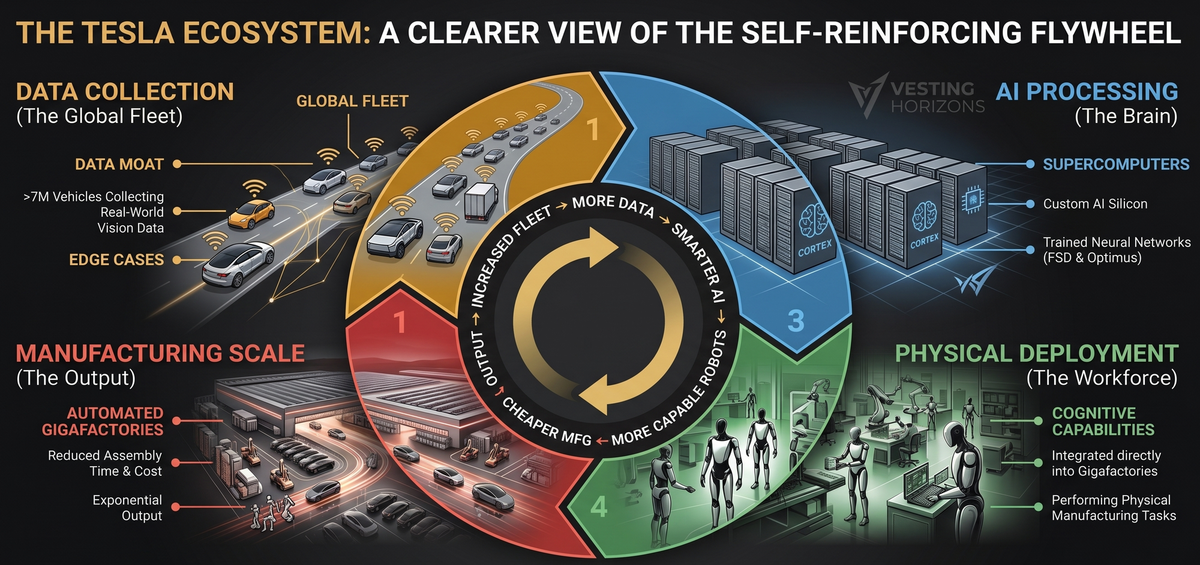
Instead of operating as isolated business divisions, Tesla functions as a continuous, closed-loop system where every vertical accelerates the development of the others.
Here is the structural flow of how the ecosystem connects:
1. Data Collection (The Global Fleet)
- The Asset: Over 7 million vehicles are currently on the road.
- The Function: These vehicles act as a massive, distributed sensor network, continuously gathering real-world vision data and complex edge cases.
2. AI Processing (The Brain)
- The Asset: Proprietary supercomputer clusters (Cortex) built using custom AI silicon.
- The Function: The massive data pool from the fleet feeds into these supercomputers, training the foundational neural networks for both autonomous vehicles (FSD) and humanoid robotics (Optimus) simultaneously.
3. Physical Deployment (The Workforce)
- The Asset: Optimus humanoid robots.
- The Function: As the neural networks mature, the resulting spatial awareness and cognitive capabilities are deployed into Optimus. These robots are then integrated directly into Tesla’s gigafactories to perform physical manufacturing tasks.
4. Manufacturing Scale (The Output)
- The Asset: Highly automated, next-generation gigafactories.
- The Function: Robotic automation and advanced manufacturing techniques drastically reduce assembly time, factory footprint, and overall production costs.
5. The Compounding Loop
- The Result: Cheaper, highly automated manufacturing allows Tesla to produce more vehicles and more robots at an unprecedented scale.
- The Cycle Repeats: More vehicles deployed $\rightarrow$ more real-world data collected $\rightarrow$ smarter AI models $\rightarrow$ more capable robots $\rightarrow$ even cheaper manufacturing $\rightarrow$ exponentially more vehicles.
The Foundational Layer
This entire physical and digital loop is supported by an internalized infrastructure stack:
- Energy Independence: Tesla's own Megapacks and solar infrastructure power the factories and supercomputers.
- Hardware Autonomy: Developing custom in-house AI chips to eliminate reliance on external suppliers like TSMC or Nvidia.
- The Broader Network: Integration with the wider Elon Musk ecosystem, utilizing SpaceX's Starlink for global vehicle connectivity and xAI's Grok for advanced digital reasoning.